Big Muff: Tone, History and Use
Electro-Harmonix’s Big Muff Pi reshaped guitar noise, sustain, and texture from its 1969 origin to the present, becoming central to noise rock, hardcore, grunge, and experimental scenes. This text outlines the pedal’s evolution, the sound signatures that made it indispensable to bands like SOFY MAJOR, and practical guidance for players, engineers, and collectors.
Big Muff through eras, makers, and scenes
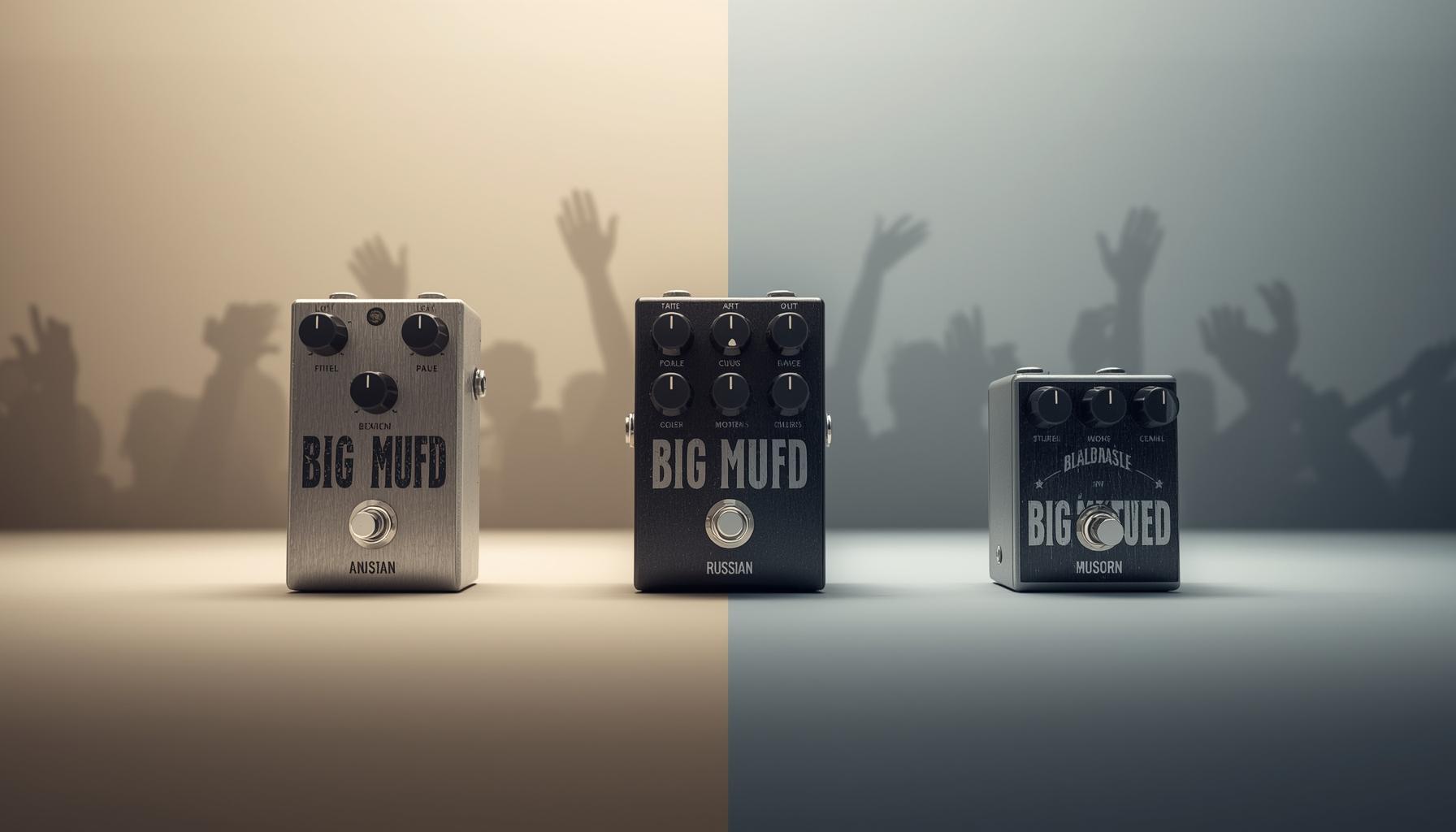
The story begins in New York City. Electro-Harmonix was founded by Mike Matthews in 1968, and the Big Muff Pi first appeared around 1969 as a compact, four-stage silicon transistor fuzz that emphasized harmonic richness and long sustain over the scooped-mid sound then uncommon in guitar effects. The earliest production models, often called the triangle because of their front-plate graphic, were built in Manhattan and circulated widely through the early 1970s, used by studio and touring musicians for massive sustain and warm distortion.
Mid-1970s variants introduced aesthetic and circuit tweaks. The Ram’s Head faceplate arrived as a visual refresh while retaining the core topology; variations through the decade changed transistors and component tolerances, altering low-end response and overall harshness. In the late 1980s and into the 1990s a Russian-manufactured line commonly referred to by the maker name Sovtek became prominent. Those units, produced with Russian components and built in St. Petersburg, delivered a beefier low end and became staples in underground scenes due to affordability and distinct character.
Punk and hardcore scenes in the 1980s adopted the pedal for its ability to cut through with aggression and sustain, while noise rock bands expanded its role beyond simple fuzz into textures of feedback, octave-like harmonic build, and extended sustain controlled by dynamics and volume swells. By the early 1990s, alternative and grunge acts used Big Muff textures on major-label records, creating a pathway for the pedal’s mainstream recognition without sacrificing underground credibility.
Midway through the historical narrative it helps to compare notable variants, their eras, and traits for players and collectors. The following grid summarizes key models, approximate production eras, circuit character, and typical market range as of 2024.
| Variant name and graphic | Approximate production era | Circuit/character notes | Typical market range (2024) |
|---|---|---|---|
| Triangle Big Muff Pi | 1969–mid 1970s | Classic four-transistor silicon stages, open top-end, pronounced sustain | $600–$1,500 |
| Ram’s Head Big Muff | mid–late 1970s | Slight component and voicing changes, warmer low end | $300–$800 |
| Op-amp and later US versions | late 1970s–1980s | Op-amp changes, clearer treble, different headroom | $200–$600 |
| Sovtek (Russian-made) | 1990s–2000s | Thick low end, aggressive mids, rugged build | $50–$200 |
| Electro-Harmonix reissues | 1999–present | Modern components, faithful recreations and variant reissues | $90–$150 |
Acknowledge that rarity, condition, and provenance drive vintage prices. For musicians focused on texture over resale, many reissues and boutique alternatives reproduce characteristic traits at accessible prices.
Tone, circuits, players, and practical integration

The Big Muff’s signature sound is a dense, compressed fuzz with long sustain, rich harmonic content, and a passive tone network that creates a scooped-mid or thick low-mid emphasis depending on revision. Circuit changes across variants — transistor types, op-amp swaps, capacitor values, and tone network tweaks — shift perceived warmth, weight, and clarity. Players commonly dial Sustain high, Tone between 11 o’clock and 3 o’clock for either darker or brighter output, and Volume to unity or slightly above amp clean level to preserve headroom.
Notable musicians across related scenes showcased the pedal’s range: David Gilmour used early Big Muffs on late 1970s Pink Floyd records for soaring solos; J Mascis of Dinosaur Jr. popularized fuzz-heavy, melodic lead lines through the 1980s and 1990s; Billy Corgan leaned on Big Muff textures during the Siamese Dream era for dense rhythm layering. In noise rock and hardcore, the pedal’s ability to produce sustained walls of feedback made it a tool for dynamics and catharsis, a tonal partner for bands that prioritize noise and meaning.
Cloning and DIY culture grew around the Big Muff because its topology is straightforward and adaptable. Home builders swap transistor types, change capacitor values in the tone stack, or add output boosters to tailor attack and low-end weight. Boutique builders reinterpret the circuit by offering modern component tolerances, true-bypass switching, and additional EQ or compression stages; makers like EarthQuaker Devices, Way Huge, and numerous custom shops produce pedals drawing on that legacy while expanding tonal control.
Integration into a pedalboard requires attention to signal ordering and buffering. Placing the Big Muff before overdrive tends to compress and thicken the signal; placing it after boosts and distortions allows the Muff to dominate texture and feedback. Because the pedal is passive at the tone stage, buffering before it stabilizes high-frequency loss, while buffering after helps maintain cable-driven tone across long signal chains. In the studio, common approaches include close-miking a cranked tube amp while capturing a DI for re-amping, and layering multiple takes with varied Muff settings to build harmonic density without cluttering the mix.
Maintenance and longevity are practical concerns for touring acts. Common faults include scratchy pots, fatigued electrolytic capacitors, cold solder joints, and worn footswitches. Regular cleaning of jacks and pots, checking battery terminals, and replacing aged electrolytics extend life. For collectors, authenticity proofs such as original graphics, pot types, and screw patterns matter when establishing provenance.
The surrounding community keeps the lore alive through online forums, trading groups, and local pedal meets. That culture emphasizes swapping mods, trading rare variants, and preserving the tactile rituals of knob tweaks and amp interaction that define how the Big Muff shapes noise, feedback, and meaning in live contexts.
Contemporary iterations continue to innovate: modern designs add multi-band EQ, switchable voicings, and digital augmentation while boutique makers explore hybrid analog-digital topologies. For bands like SOFY MAJOR that inhabit noise, feedback, and philosophical intensity, the Big Muff remains both a historical artifact and a living tool capable of producing new, disruptive textures that connect volume, sustain, and existential weight onstage and in the studio.